12.18.2025
Interstruct’s HQ mural illustrates the power of art + development
by Susan Moynihan and Megan Padilla
Interstruct Design + Build CEO Ryan Young is a passionate advocate on the role of public art in commercial development. He is often invited to speak on the subject at industry panels and in interviews. It’s easy to see why: At Interstruct’s HQ in Parramore, public art is baked into the DNA. And it continues to fuel Interstruct’s redevelopment in Parramore, activating a segment of the growing West Church Corridor and fueling community engagement.
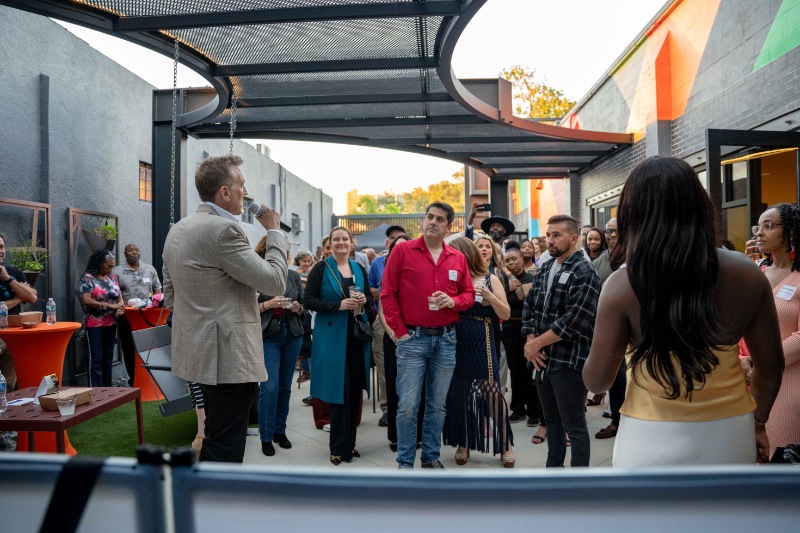
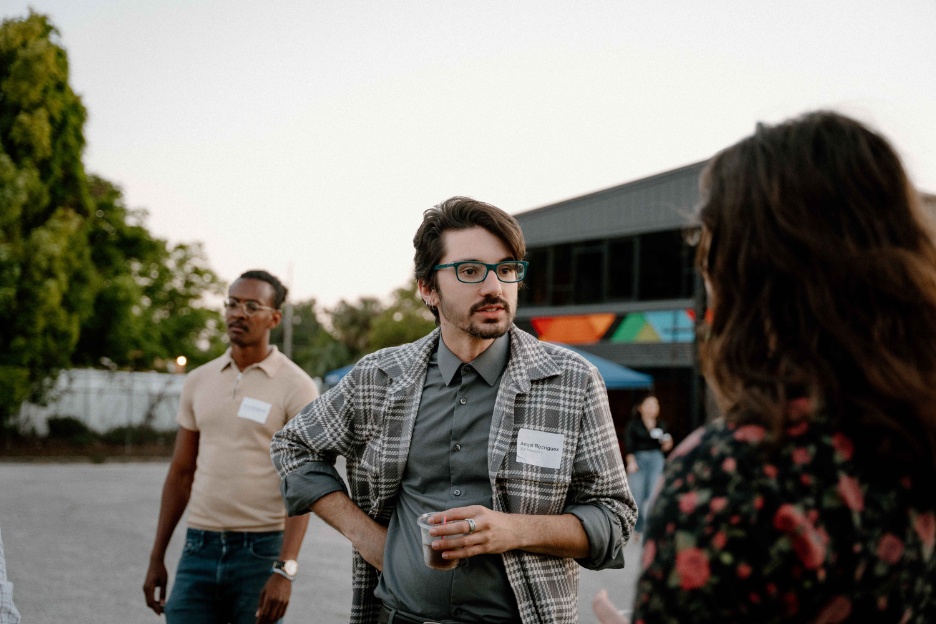
It all comes together at Interstruct Connect, the quarterly after-hours networking event tied to Third Thursday Orlando. It draws hundreds of guests to Interstruct’s Orlando HQ, to enjoy food and friendship, to learn about the inspiring work by a community partner serving the residents of Parramore, and to celebrate the opening of a new installation at ArtCube, a shipping container micro-gallery that showcases multimedia work by local artists.
And to think, it all started with a mural that was supposed to be a stand-in for the promise of future redevelopment.
Video by T. Ramzy Media
Merging Art + Architecture for Community Intent
Buying a building to become the new headquarters of Interstruct was more than a real estate investment to Ryan Young. A building is part of a community, and buying the building in Parramore meant integrating into the neighborhood, which was part of the appeal. Young and business partner Rich Monroe have a long interest in adaptive reuse as a tool for revitalization, and Parramore was an ideal spot to prove their passion.
When they first purchased the building, Young wanted to use the exterior to show the community that changes were taking place, and create a spark for conversation. This was during the height of the pandemic and in June 2020, he commissioned artist Maureen Hudas to create a mural. They ended up with a striking portrait of community activist Jennifer Desir Hilaire, placed at the center of a circle of color that radiated expanding lines of light. At the time, Hilaire was organizing local Black Lives Matter protests and distributing hygiene kits to the unhoused — entirely self-funded and largely invisible to the public eye. Highlighting her in the mural was Interstruct’s way of honoring her work and expanding the word of what she and her volunteers were doing.

The mural that sparked an enduring and powerful partnerhsip
The Unity Mural started as a public art project, but it quickly turned into an enduring partnership. Young and Hilaire didn’t know each other before the mural, but after seeing her work in the community, Young offered financial and logistical support to help expand on her efforts. That friendship led to the founding of The Desire Foundation, Inc., which now serves hundreds of residents each month in and around Parramore. Interstruct is a founding partner and ongoing financial supporter, and both Young and Hudas serve on its board.
“This has really taught me what community means,” said Young. “It’s not writing a check. It’s showing up. It’s building relationships. It’s listening.”

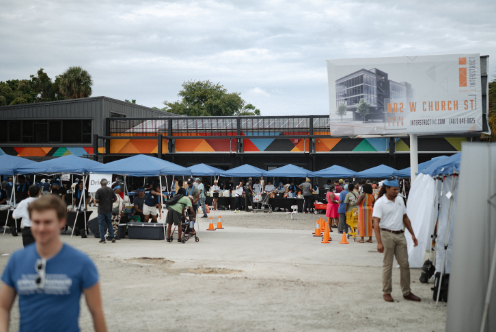
The Desire Foundation, Inc. and Interstruct partner on Project 814 to provide free groceries and more at monthly events held at Interstruct’s office in Parramore. Photos by T. Ramzy Media.
When Interstruct moved into its new headquarters in 2021, the mural was decommissioned to complete the architectural facade of the building: a transparent Corten steel architectural screen that provided transparency to the original 1940s parapet façade and reintroduced the building to the street, sidewalk and pedestrians. It was a statement blending old and new, showing how a historic building could be transformed and updated rather than being torn down
814 W. Church Street Before the Mural

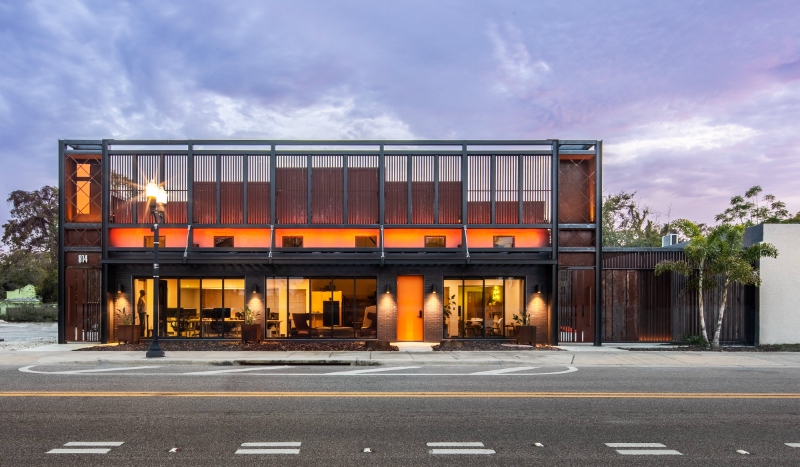

Photos by Chad Baumer
Once completed, Young felt they still weren’t quite finished. “This building has evolved as we’ve lived with it. Once the construction wrapped, we realized it still needed something. Not a structural change — an emotional one.” The architecture team had designed a brick veneer that stopped 10 feet from the top. They realized that continuous space would be a wonderful mural band on three sides of the building.
Young reached out to Bill Shugart of Locol Arts, a creative consultancy that connects developers and designers with working artists. Shugart and Young had already collaborated on a series of commissioned works by Florida artists for Interstruct’s private art collection.
Shugart immediately thought of Carissa Bloemeke, a senior graphic designer with Tavistock Development Company, who understands how design can work holistically with architecture and branding.
“For my mural work, I like to consider an overall concept for a deeper meaning,” says Bloemeke, reflecting on how she approached the project. “And I like to work with the architecture of the intended space.”
Why Bloemeke chose color blocking for the mural
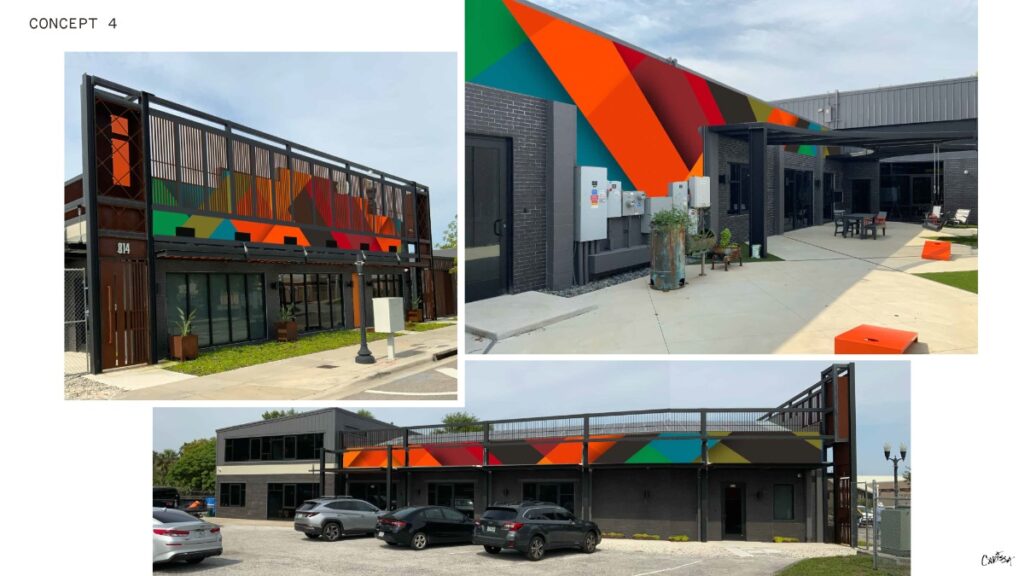
Bloemeke’s concept wrapped all three visible sides of the building in an elevated band of bold color blocking—essentially a horizontal ribbon of visual energy.
She began with a warm orange hue, reflecting Interstruct’s branding and company ethos, and added on from there. “I focused on those warm colors to draw people in and give them a warm feeling,” she says. “Using a variation of colors across the building allows the viewer to have a path and a story to follow—it draws the viewer in to experience the mural.”
Rather than covering the whole building with paint, as most muralists do, her design left large areas of raw space that exposed the building itself, blending history of old and new and illustrating the power of adaptive reuse.
Young signed off and then invited his longtime creative collaborator Maureen Hudas to execute the mural onsite.
A Final Element Continues a Community Story

Photo by Ricardo Hernandez
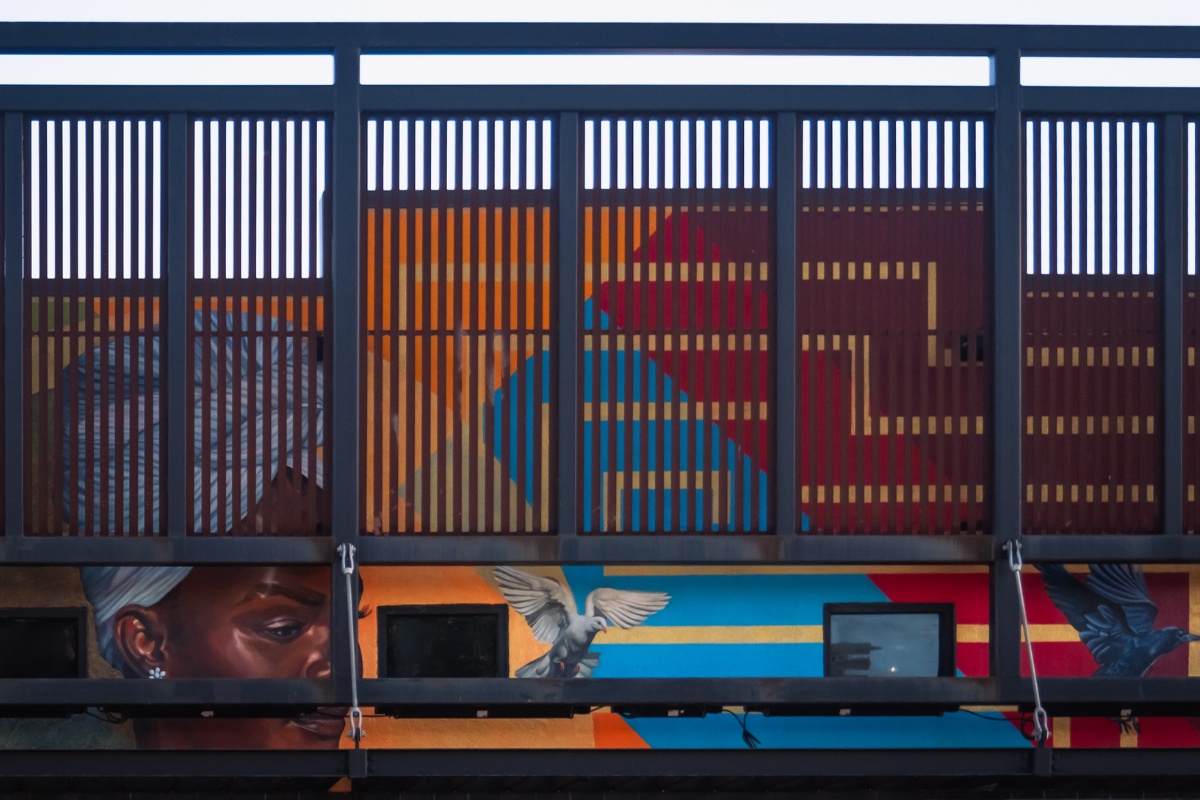
During the painting process, a new idea emerged. Young suggested that Hudas bring back elements of the original Unity Mural— specifically, the portrait of Jennifer Desir Hilaire that had been a focal point.
“It was such an important piece. To bring it back, in some form, just felt right,” said Hudas. “When I dropped those original elements into the new design and sent it to Ryan for scale, he immediately approved.”
Working within the narrow 18-inch gap between the building and the Corten steel architectural screen, Hudas carefully reintroduced Hilair’s likeness. Framed by architectural lines and shadows, it remains visible between slats — still centered in a circle, still holding space. The result is powerful layers of past and present, both physically and symbolically.
“It doesn’t happen often that you get to revisit something you thought was temporary,” Hudas says. “But this piece — this partnership — became something much bigger. I love that we got to bring that heart back in.”
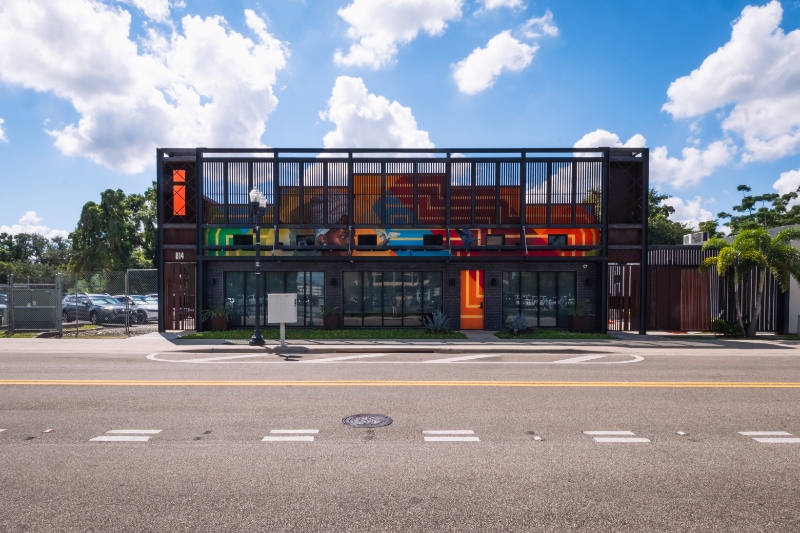
The element is a central feature of the mural, which extends across three walls. The east-side parking lot/front and the west-side courtyard maintain Bloemeke’s vibrant color-blocked bands, while the front façade blends the old and new, anchoring the building in memory and intention.
Art + Architecture Creates a Community Gathering Place

Photos T. Ramzy Media
As a public art project, the Unity Mural served a dual purpose of beautifying their headquarters and helping them become part of the neighborhood. Excited by the possibilities of public art as a tool to build community, in 2023 the team designed, built and curated ArtCube, a retrofitted shipping-container gallery that showcases quarterly artist installations. Thus, Parramore Arts—an umbrella of Interstruct’s public art offerings as a gallery without walls — was launched.
Curated by longtime Orlando gallerist and art critic Pat Greene, ArtCube features digital, projection, and immersive works that are visible from the sidewalk 24/7 — and it serves as a centerpiece for ongoing community events at Interstruct, such as the quarterly Interstruct Connect networking events.
“We’re interested in meaning. What’s the story? What’s the narrative?,” says Young. Part of the project’s purpose was to commission work from artists who have a desire to engage with the Parramore community.
One recent installation by Peterson Guerrier recreated the interior of a public bus, complete with salvaged seats and immersive video, which highlights the often-overlooked experiences of Orlando’s transit riders.
“When someone asked what he wanted people to feel, Peterson said one word: empathy,” says Young. “That stuck with me. That’s what powerful art does. It shifts your perspective.”
Art also reflects what’s meaningful. Consider Bloemeke’s mural, which wraps around three sides of Interstruct headquarters. The effect is intentional and purposeful.
“I don’t do a full coverage on the building; it’s more pieces and parts that give depth and layers to the mural,” she says. “It makes it feel a little bit more purposeful that way.” That intentional approach reflects Interstruct’s community-centric mission. “It gives a connection to [Interstruct] because you’re so integrated with the community,” she says. “The mural is integrating with the building, you’re integrating with the community — it’s all different pieces and parts, layering together.”
Young often says that good architecture tells a story. In Parramore, the effect is visible and the story is always continuing.
814 W. Church St Complete with Mural


Photos by Ricardo Hernandez
Billboard Art Comes to Parramore
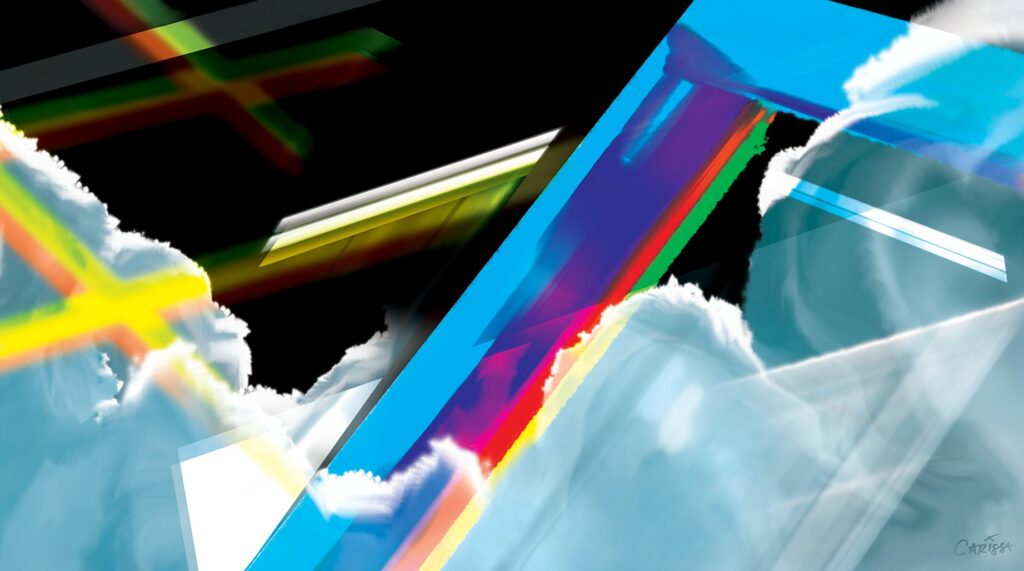
Interstruct’s gallery-without-walls expands with custom-commissioned billboard works by Orlando artist Carissa Bloemeke. Read the full post here.